

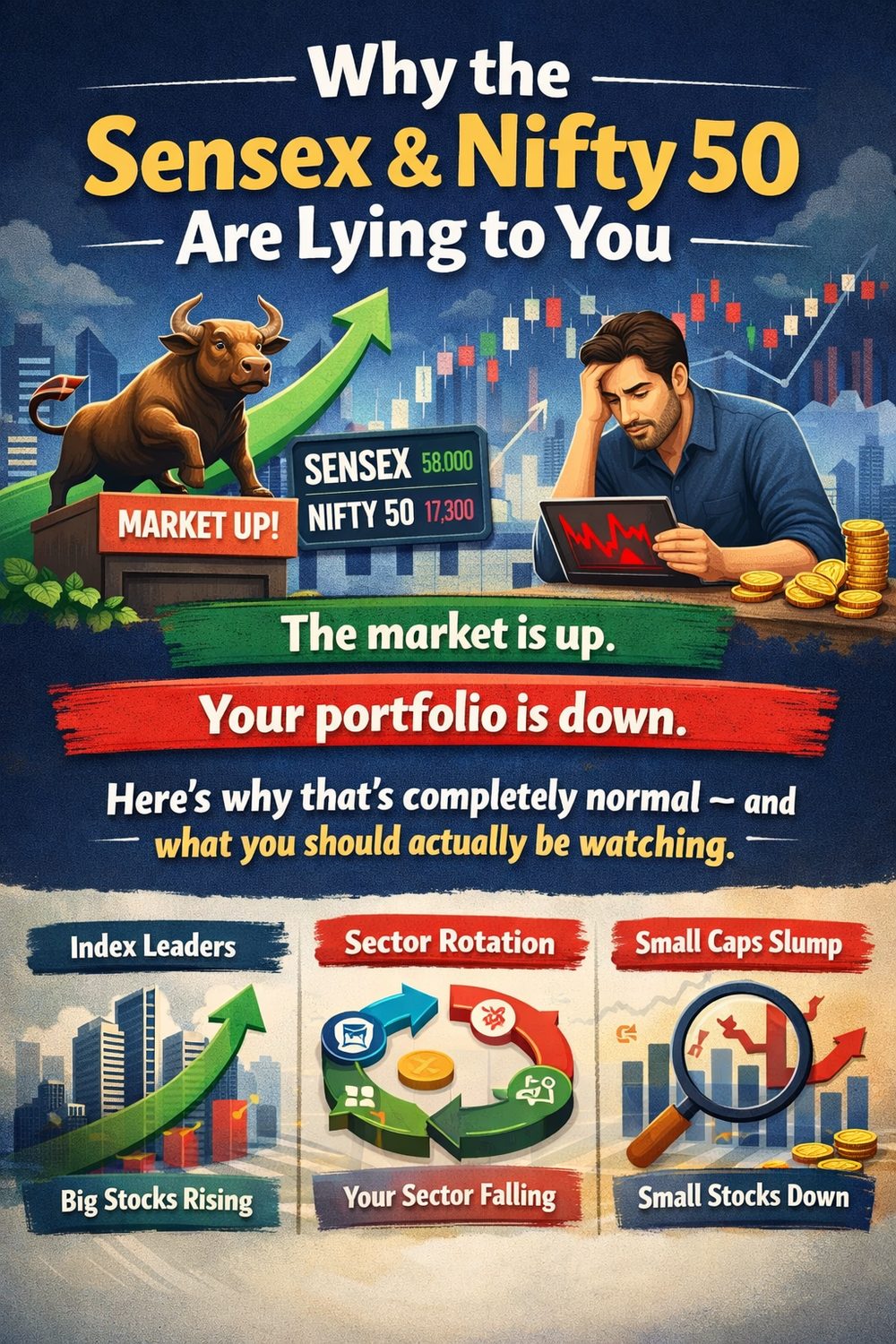
You open your brokerage app on a Monday morning. The Nifty 50 is up 1.8%. The Sensex is flashing green. The financial news channels are celebrating. And then you look at your own portfolio — and it's a sea of red.
Sound familiar? You're not alone. Millions of Indian investors make the mistake of measuring their portfolio's health against the Nifty or Sensex. But these two indices — as popular and widely quoted as they are — are deeply flawed mirrors. They tell you how a very specific slice of corporate India is performing. They tell you almost nothing about how your money is actually doing.
Let's break down exactly why — and, more importantly, what you should be tracking instead.
The Market-Cap Weighting Illusion: A Few Giants Run the Show
The Nifty 50 and Sensex are not simple averages. They are market-capitalisation weighted indices, which means larger companies command a disproportionate influence over the number you see on your screen every day.
Think about it this way: if Reliance Industries, HDFC Bank, Infosys, TCS, and ICICI Bank together make up roughly 40–45% of the Nifty 50's total weight, a good day for these five behemoths can push the index higher — even if the remaining 45 stocks are quietly declining. The index smiles while most of its components suffer.
For the average retail investor, whose portfolio is spread across various sectors and company sizes, this concentration means the index's movement has very little correlation with how your actual holdings perform on any given day.
The Nifty 50 can be positive if just the top 5 heavyweight stocks rise — even if 40 out of 50 stocks in the index are falling. Your portfolio almost certainly doesn't replicate this concentration.
Sector Concentration Bias: The Index Favours Certain Industries
Look under the hood of the Nifty 50 or Sensex and you'll find a heavy tilt toward three sectors: Financial Services, Information Technology, and Energy. Together, they typically account for over 60% of the index's total weight. The rest of the economy — pharma, FMCG, infrastructure, telecom, chemicals, textiles, auto ancillaries — gets crammed into the remaining fraction.
| Sector | Approx. Nifty Weight | Retail Investor Exposure |
|---|---|---|
| Financial Services | ~33% | Moderate |
| IT & Technology | ~14% | Moderate to High |
| Energy & Oil | ~12% | Low to Moderate |
| FMCG, Pharma, Infra | ~25% | Often Higher |
| Mid & Small Caps | 0% (Excluded) | Very Common |
So if you're invested in pharma companies riding a post-pandemic slowdown, infrastructure stocks awaiting government capex, or chemical companies navigating global headwinds — the Nifty's performance is almost irrelevant to your situation. Your "benchmark" is misaligned from the start.
Instead of comparing your pharma or FMCG holdings to the Nifty 50, compare them to a sector-specific index like the Nifty Pharma Index or Nifty FMCG Index. That gives you a meaningful benchmark.
The Mid & Small Cap Gap: Where Most Retail Portfolios Actually Live
Here's the elephant in the room: the Nifty 50 and Sensex track only large-cap stocks. They represent roughly the top 100 companies by market capitalisation. But an enormous portion of the retail investing universe consists of mid-cap and small-cap companies — stocks that can swing 30–60% in either direction in a single year, completely independent of what the large-cap index does.
The divergence can be stunning. In 2018, the Nifty 50 ended the year roughly flat, down only about 3%. But the Nifty Midcap 100 index fell over 15%, and many individual mid and small-cap stocks crashed 40–70% from their peaks. Investors who watched the Nifty and assumed their portfolio was "safe" were in for a brutal shock.
In 2018 and again in late 2021–2022, the Nifty 50 was nearly stable or mildly positive — but the Nifty Smallcap 250 index was down 15–25%. Investors comparing against Nifty felt falsely reassured while their portfolios eroded significantly.
The reverse is also true. In roaring bull markets, mid and small-cap stocks can deliver 2–3x the returns of large-cap indices. Comparing your portfolio's stellar performance to a conservative large-cap index might make you underestimate the risk you took to achieve it.
The rule of thumb: compare like with like. If you hold mid-cap stocks, your benchmark should be the Nifty Midcap 150. Small caps? Use the Nifty Smallcap 250. A blended portfolio needs a blended benchmark.
"The index going up doesn't mean you made money. The index going down doesn't mean you lost as much as you think. The only number that matters is your own XIRR."
— A truth every Indian investor must internalizeSurvivorship Bias: The Index Only Shows You the Winners
There's a quiet mechanic at work inside every index that most investors never think about: periodic rebalancing. Nifty and Sensex are not static. Every few months, NSE and BSE review their compositions. Underperforming stocks get quietly dropped and replaced with stronger performers.
This is survivorship bias in action. The index you see today is a curated collection of companies that survived and thrived long enough to be included. The failures, the frauds, the companies that fell from grace — they've already been removed. You never see their losses dragging down the index number.
Companies like Yes Bank, Vodafone Idea, Jet Airways, and DHFL were once index heavyweights. When they crashed, they were removed from indices — but if you held them in your portfolio, those losses were very real and very permanent. The index moved on. Your portfolio didn't.
Your personal portfolio has no such self-cleaning mechanism. The stocks you bought and forgot about don't get auto-replaced with better ones. The losers stay, dragging down your returns. This is perhaps the most underappreciated structural difference between index performance and real investor experience.
The Dividend Blind Spot: The Index You See Is Incomplete
When you see Nifty at, say, 24,000 points on a financial news channel, you are looking at the Price Return Index — a number that only reflects stock price movements and completely ignores dividends. This is the version shown on almost every financial channel, app, and website in India.
The more accurate version — the Nifty 50 Total Return Index (TRI) — reinvests dividends back into the index. Historically, dividends add roughly 1–1.5% to annual returns. Over 10–20 years, that difference compounds into a significantly larger number.
| Index Type | Includes Dividends? | Commonly Shown in Media? |
|---|---|---|
| Price Return Index (PRI) | No | Almost Always |
| Total Return Index (TRI) | Yes | Rarely Quoted |
SEBI mandated in 2018 that mutual funds must benchmark their performance against the Total Return Index (TRI), not the Price Return Index. If you're evaluating a fund, make sure it's being compared to TRI — otherwise the fund may appear to outperform when it actually doesn't.
Your Entry Price Changes Everything: Timing Is Personal
The Nifty 50 has delivered roughly 12–14% annualised returns over the past two decades. Impressive. But that number is measured from a fixed starting point — the index's base date. Your returns are measured from the day you personally put your money in.
Invest a lump sum at a market peak in January, and even if the Nifty is technically "up 10% for the year" by December, you could still be sitting at a loss because you bought at the highest point. The index doesn't care about your entry price. Your portfolio very much does.
The Nifty peaked near 18,600 in October 2021. Someone who invested a lump sum then saw the index fall approximately 17% over the next year. Even when the index "recovered," their personal returns were flat or negative for over 18 months — despite positive headline returns being quoted during the same period.
This is why point-to-point index returns — "Nifty gave 15% this year" — can be dangerously misleading. The market doesn't know when you entered. Only you do. Your personal cost of acquisition is the only relevant starting point for measuring your returns.
SIPs vs. Index Returns: A Fundamentally Different Journey
Systematic Investment Plans (SIPs) are the most popular way Indians invest in mutual funds — and they have a radically different return profile than the point-to-point index number you see quoted.
When you invest via SIP, you're buying units at different prices every month. In falling markets, you buy more units at lower prices. In rising markets, fewer units at higher prices. Your actual return — measured as XIRR (Extended Internal Rate of Return) — depends entirely on this specific sequence of investments and their timing.
A classic confusion: a mutual fund or index shows "12% CAGR over 5 years." But an SIP investor who started at the beginning of that same 5-year period might have earned a very different XIRR — higher if markets fell mid-period (letting them accumulate cheaper units), or lower if the index ran up quickly at the start. The headline number simply doesn't apply to your SIP journey.
Always calculate your XIRR using your actual investment dates and amounts. Most brokerage platforms like Zerodha, Groww, and Coin display this. It is the only fair measure of how your SIP is performing relative to the index's XIRR over the same period.
Concentration Risk: The Index Diversifies So You Don't Have To
The Nifty 50 holds 50 stocks across multiple sectors. The Sensex holds 30. This built-in diversification acts as a natural shock absorber. When one sector crashes, other sectors often cushion the blow, keeping the index relatively stable.
Now compare this to a typical retail investor's portfolio: perhaps 8–15 stocks, often concentrated in one or two sectors the investor understands or finds exciting. One bad stock, one corporate fraud, one sector-specific headwind — and it can devastate your portfolio's performance even as the broader index hums along quietly.
If you hold 10 stocks and one of them falls 70% (think Yes Bank, PC Jeweller, or Vakrangee), it wipes out 7% of your portfolio in a single stroke. The Nifty 50's exposure to that same stock might be 0.5–1%, making the impact almost invisible at the index level.
This is not an argument against focused investing — concentrated portfolios have produced legendary returns. But it IS an argument against using the Nifty as your yardstick. A diversified index and a concentrated portfolio are playing fundamentally different games.
- Nifty 50: 50 stocks, multiple sectors, large-cap only — built-in risk management through diversification
- Your portfolio: 8–15 stocks, sector biases, mixed market caps — a highly personal risk profile the index cannot represent
- Nifty auto-rebalances by removing weak stocks every quarter, keeping only the strongest
- Your portfolio holds losers until you manually decide to sell — there's no automatic cleanup
- Index impact from a single stock crash is muted by its weight cap
- Your portfolio's impact from one bad stock can be catastrophic with no buffer
So, What Should You Actually Track?
The Nifty 50 and Sensex are useful macroeconomic barometers. They tell you about market sentiment, institutional flows, and the health of India's largest corporations. They are NOT designed to be personal portfolio benchmarks.
Here's what you should be measuring instead:
- XIRR — Your actual rate of return accounting for every rupee invested and when it was invested. The gold standard for SIP investors and anyone with multiple transactions.
- Right Benchmark Index — Mid-cap holdings vs. Nifty Midcap 150. Pharma stocks vs. Nifty Pharma. Small-caps vs. Nifty Smallcap 250. Always compare like with like.
- Alpha — Did you beat your relevant benchmark after accounting for the risk you took? Positive alpha means you added value beyond what a passive index approach would have given you.
- Total Return Index (TRI) — For mutual funds, always compare performance against the TRI that includes dividend reinvestment, not the price-only index.
- Real Return — Subtract inflation. A 10% nominal return in a 6% inflation environment is just 4% real wealth creation. Always keep inflation in the picture.
The bottom line: Nifty and Sensex are powerful tools for reading market mood. But they were never built to be your personal report card. The sooner you stop comparing your portfolio to these indices and start measuring your actual XIRR against a relevant benchmark, the clearer — and more honest — your financial picture will become.
Invest smart. Measure right. And the next time someone tells you "the market is up 2%," smile — and go check your own numbers.