"Your phone opens. Zerodha. Groww. Kuvera. You know the NAV before you know the weather. Sound familiar?"
We've All Been There
It starts innocently enough. You invest your first ₹5,000 in a large-cap fund. You're told to stay invested for 10 years, think long-term, don't panic. You nod along. Then Monday morning arrives, and you open the app — just to "check".
That first check becomes a habit. The habit becomes a ritual. Before long, you're refreshing your portfolio at 9:15 AM when markets open, at lunch, during meetings, and right before bed. Your spouse thinks you're doom-scrolling. You know better. Or do you?
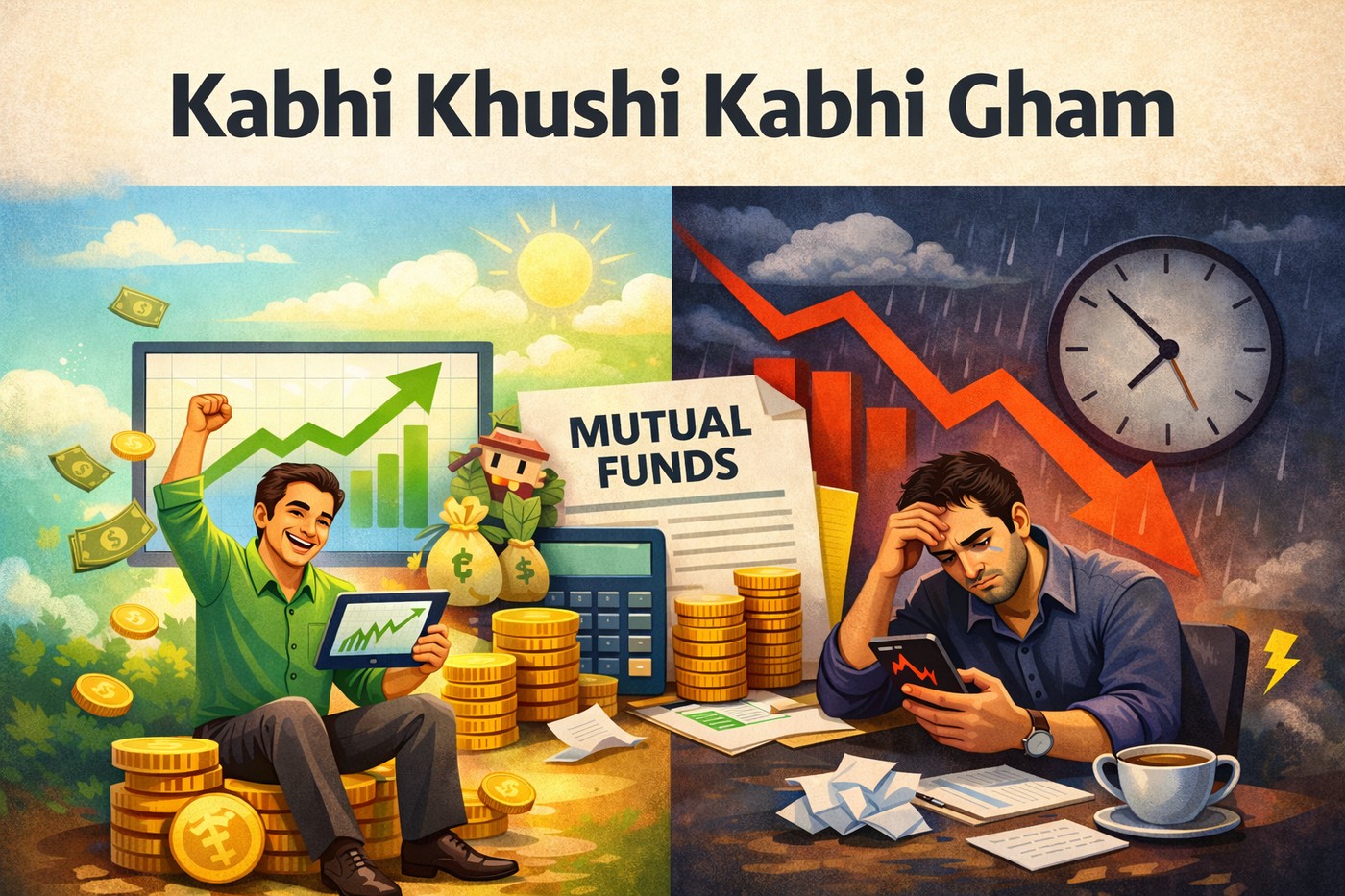
Welcome to the brotherhood (and sisterhood) of the obsessive mutual fund tracker — where every green day feels like Hrithik Roshan dancing in a Swiss meadow, and every red day feels like Amitabh Bachchan delivering tragic monologues in the rain. Kabhi khushi, kabhie gham. Every. Single. Day.
The Khushi Days vs The Gham Days
For a daily portfolio-watcher, there is no neutral. The market gods have declared: thou shalt either celebrate or mourn. Here's how the same investor behaves on opposite days:
The Khushi Days
- Opens app 7 times before lunch
- Forwards returns screenshot to family WhatsApp
- Considers himself the next Warren Buffett
- Adds to SIP without any analysis
- Tells colleagues investing is "easy"
- Sleeps soundly, dreams of early retirement
The Gham Days
- Avoids the app like it owes him money
- Googles "is the market going to crash 2026"
- Questions every fund manager's qualification
- Considers stopping SIP "temporarily"
- Blames RBI, Fed, geopolitics, monsoon
- Searches for "best FD rates" at midnight
The tragedy? The fund hasn't changed. The fund manager hasn't changed. Your financial goals haven't changed. Only the NAV moved — and with it, your entire emotional universe.
The market will give you 365 emotional experiences a year. Your job is to have none of them affect your decisions.
The first rule of long-term investingWhy Your Brain Is Wired Against You
Here's the uncomfortable truth: daily portfolio checking isn't just a habit. It's a psychological trap backed by decades of behavioural finance research. Two forces are working against you every time you open that app.
Loss Aversion: Daniel Kahneman's Nobel Prize-winning work showed that losses feel roughly twice as painful as equivalent gains feel pleasurable. So when your ₹2 lakh fund goes down ₹3,000 on a Tuesday, the pain you feel is disproportionately larger than the joy you'd feel if it went up ₹3,000. Every red day hits harder than every green day rewards. Daily checking means you're constantly losing that asymmetric battle.
Myopic Loss Aversion: The more frequently you evaluate your portfolio, the more "losses" you see — even in a fundamentally rising market. A fund that returns 14% annually might show negative returns on 40–45% of individual days. If you check daily, you're experiencing loss almost half the time, even in a winner. Check monthly? You might see losses on 20–25% of months. Check yearly? Almost never.
The data is humbling. A 12% CAGR fund doesn't deliver a smooth upward line — it zigzags violently every day. The investor who sees only the annual line stays calm. The investor who watches every zigzag eventually breaks.
What Daily Tracking Actually Costs You
The cost of obsessive portfolio checking isn't just emotional. It's financial. Here's how the daily tracker quietly sabotages his own wealth:
The Panic Redemption
Markets drop 4% over three days. The daily watcher, having experienced each of those drops personally and viscerally, redeems his fund. He misses the 8% recovery over the next two weeks. This sequence — panic sell, miss recovery — is the most expensive mistake in retail investing. It happens almost exclusively to daily trackers.
The Unnecessary Switch
Your midcap fund underperforms for two months. You switch to a fund that's been performing well recently — classic recency bias. What you didn't see: midcap cycles, and your old fund was about to bounce. Fund switching based on short-term NAV movement is almost always value-destructive.
The SIP Pause
Markets are volatile. You pause your SIP "until things settle down." Things settle down when the market has already recovered significantly. You've just missed buying at the lowest prices — exactly the opposite of what a SIP is designed to do. The SIP works best when you let it run on autopilot through the chaos.
The Mental Real Estate
This one has no rupee value, but it's enormous. The cognitive bandwidth you spend checking, worrying, debating, and second-guessing your portfolio every day is bandwidth stolen from your work, your relationships, and your peace of mind. Anxiety is expensive in ways that don't show up on a balance sheet.
The Compounding Irony
You invested in mutual funds to let compounding work its magic over 15–20 years. But by checking daily and reacting emotionally, you're actively interrupting the very process you came here for. The fund can't compound if you keep pulling out. The magic only works on the patient.
How to Break Up With Daily Checking
We're not saying abandon your investments and never look. We're saying build a healthier relationship with your portfolio — one where you're the investor, not the anxious spectator. Here's how:
Set a Review Calendar, Not a Refresh Habit
Block one Saturday per quarter for your portfolio review. That's it. In that session, ask: Is my asset allocation still appropriate? Am I on track for my goals? Is there a fundamentally broken fund (not just underperforming for 2 months)? If the answer to all three is "fine," close the app and enjoy your weekend.
Measure Progress, Not Performance
Stop asking "how is my fund doing?" and start asking "am I on track to reach ₹1 crore by 2038?" These are completely different questions. One is driven by market noise. The other is driven by your life goals. When you track progress toward goals, short-term NAV movements become irrelevant noise.
Delete the App from Your Home Screen
Not uninstall — just move it. Friction is a powerful behavioural tool. If checking your portfolio requires you to search for the app rather than just tapping it reflexively, you'll do it far less often. Most of your daily checks are habitual, not intentional. Remove the reflex trigger.
Write an Investment Policy Statement
This is a one-page document you write when calm and rational, that outlines: your goals, your time horizon, your asset allocation, and the specific conditions under which you will make changes. When markets go haywire and your emotions scream "sell!", your IPS is the adult in the room. Follow the document, not the feeling.
Automate Everything You Can
SIP on autopay. Rebalancing on a fixed annual date. Step-up SIP triggered automatically every April. The less you have to actively decide, the less opportunity there is for emotional interference. The best investment decisions are often the ones you made before the emotional moment arrived.
The stock market is a device for transferring money from the impatient to the patient.
Warren BuffettThink Like a Farmer, Not a Trader
A farmer plants seeds in June. He doesn't dig them up every morning to check if they've grown. He doesn't panic when it rains too much one week, or there's a dry spell the next. He trusts the process. He knows the harvest is in October — and he acts accordingly.
The obsessive daily portfolio checker is digging up his seeds every morning. Not only is he not helping the growth — he's actively damaging it.
Your mutual fund SIP is a long-term crop. The fund manager is the soil. Time is the rain. Your job is to plant consistently, stay out of the way, and show up at harvest time. That's the entire job description of a long-term mutual fund investor.
Every Bollywood drama eventually reaches an interval. The daily market drama you're watching has no interval — it runs 365 days a year, 5 days a week, and the emotional stakes feel impossibly high each time. The trick is to stop watching the movie daily and just check the final score when the film is done.
Khushi aur Gham — Dono Temporary Hain
The green days will come. So will the red ones. Markets will crash, recover, surge, correct, and confuse everyone — professional fund managers included. None of this is in your control.
What is in your control: how much you invest, how consistently you invest, how long you stay invested, and most critically — how little you let the daily drama affect your decisions.
The investors who build real wealth in mutual funds are not the ones who tracked every NAV movement. They're the ones who set up a SIP in 2005, occasionally rebalanced, ignored the 2008 crash, ignored the 2020 pandemic crash, and checked in 2026 to find they had more money than they knew what to do with.
So the next time you feel the urge to open that app for the fifth time today — pause. Ask yourself: has my goal changed? Has my time horizon changed? Has something fundamentally broken in my fund? If the answer is no, close the phone. Make some chai. Let the money grow in peace.
The best thing you can do for your portfolio is often nothing at all.
Invest with patience.
Check with intention.
The market will always give you a reason to worry and a reason to celebrate. Your wealth is built in the spaces between those reactions.