AMFI-Registered Mutual fund Distributors
AMFI-Registered Mutual fund Distributors

Systematic Investment Plans (SIPs) have transformed retail investing in India. Millions of investors invest every month, trusting discipline over timing.
Yet, despite choosing the right strategy, many investors sabotage their returns.
Not because of market crashes.
Not because of poor fund selection.
But because of excessive vigilance.
Today, Indian investors can:
What was once quarterly information is now available every minute.
But more information does not always mean better decisions.
The core principle of SIP is rupee cost averaging:
Over time, this averages out your purchase cost.
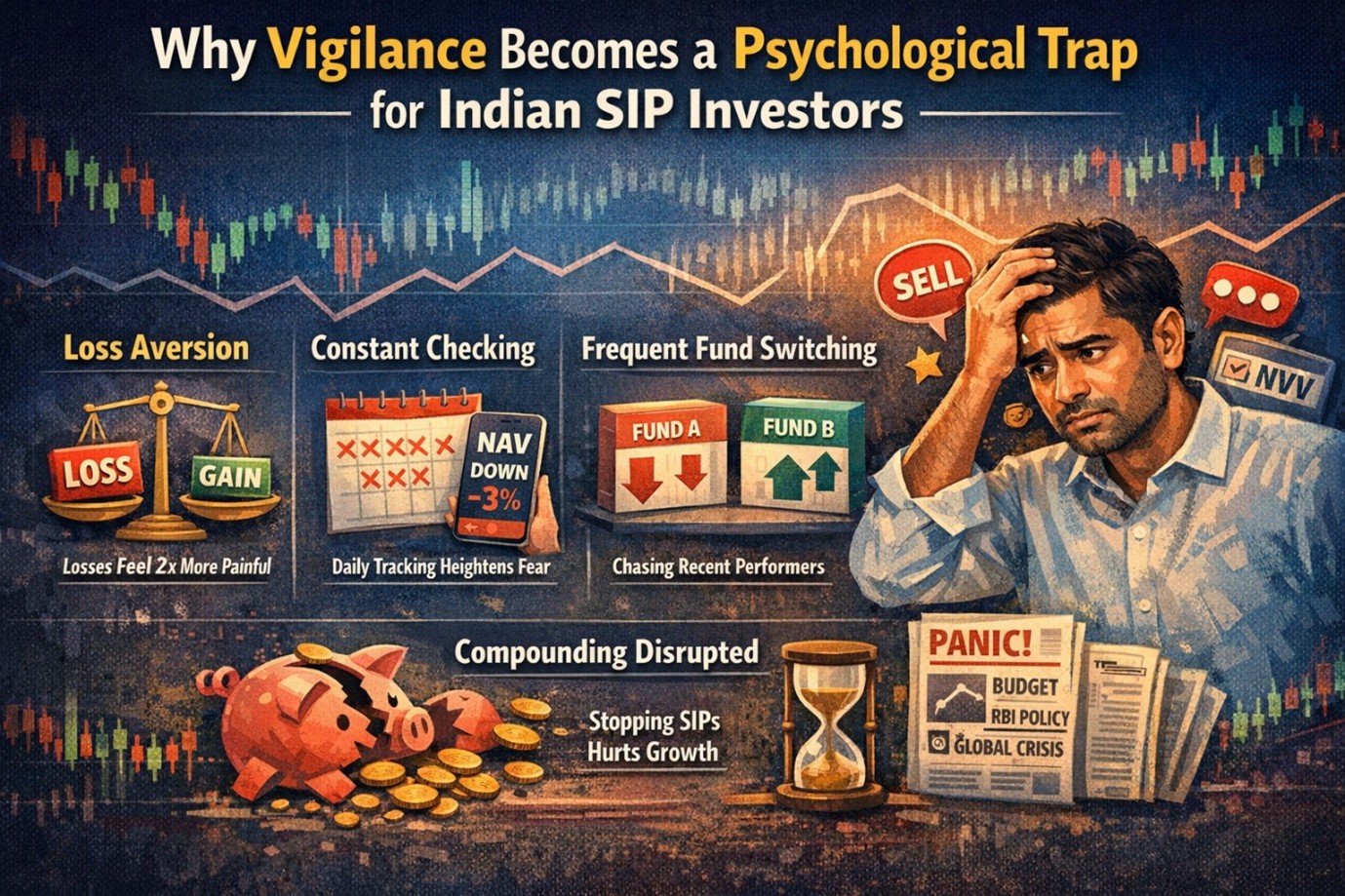
However, when investors check portfolios daily:
During the 2020 market crash, many investors stopped SIPs. Those who continued benefited significantly from lower average buying prices when markets recovered.
The irony? SIP works best when you ignore it.
Behavioural economist Daniel Kahneman showed that losses feel roughly twice as painful as equivalent gains feel pleasurable.
When you check your portfolio:
Frequent monitoring increases perceived risk — even if actual long-term risk remains unchanged.
Indian investors often:
This behaviour creates a cycle:
In investing, activity often reduces returns.
Indian markets are constantly influenced by:
Each headline creates urgency.
If your SIP goal is 15–20 years away (retirement, child’s education, financial independence), short-term noise rarely alters long-term trajectory.
Excess vigilance converts information into anxiety.
Compounding is simple but emotionally demanding.
Stopping SIPs during downturns breaks accumulation momentum.
Frequent switching adds tax friction and opportunity cost.
Vigilance, when excessive, interrupts compounding.
| Healthy SIP Discipline | Psychological Trap |
|---|---|
| Quarterly review | Daily portfolio checking |
| Annual rebalancing | Emotional fund switching |
| Increase SIP with income growth | Stop SIP during corrections |
| Goal-focused investing | NAV-focused anxiety |
India’s long-term economic growth, increasing financial literacy, and rising equity participation create structural opportunity.
The true advantage of SIP is automation.
Your edge is not prediction.
It is emotional discipline.
In long-term investing, boredom is not weakness — it is strength.
Vigilance is essential while designing your asset allocation and selecting funds.
But once your system is in place, excessive monitoring becomes psychological interference.
Markets will fluctuate.
Headlines will amplify fear.
Apps will show red numbers.
Your job is simple: Stay consistent.
Because for Indian SIP investors, the biggest risk is not volatility — it is reaction.
Welcome to COGNITY WEALTH, a one-stop destination for comprehensive and dependable financial solutions. In a world where financial decisions shape life’s most important milestones, we aim to make those decisions easier, smarter, and more rewarding.

221 , Second Floor , Sebiz Infotech Private Limited , Sector 67 , Mohali Pincode - 160062


  |