
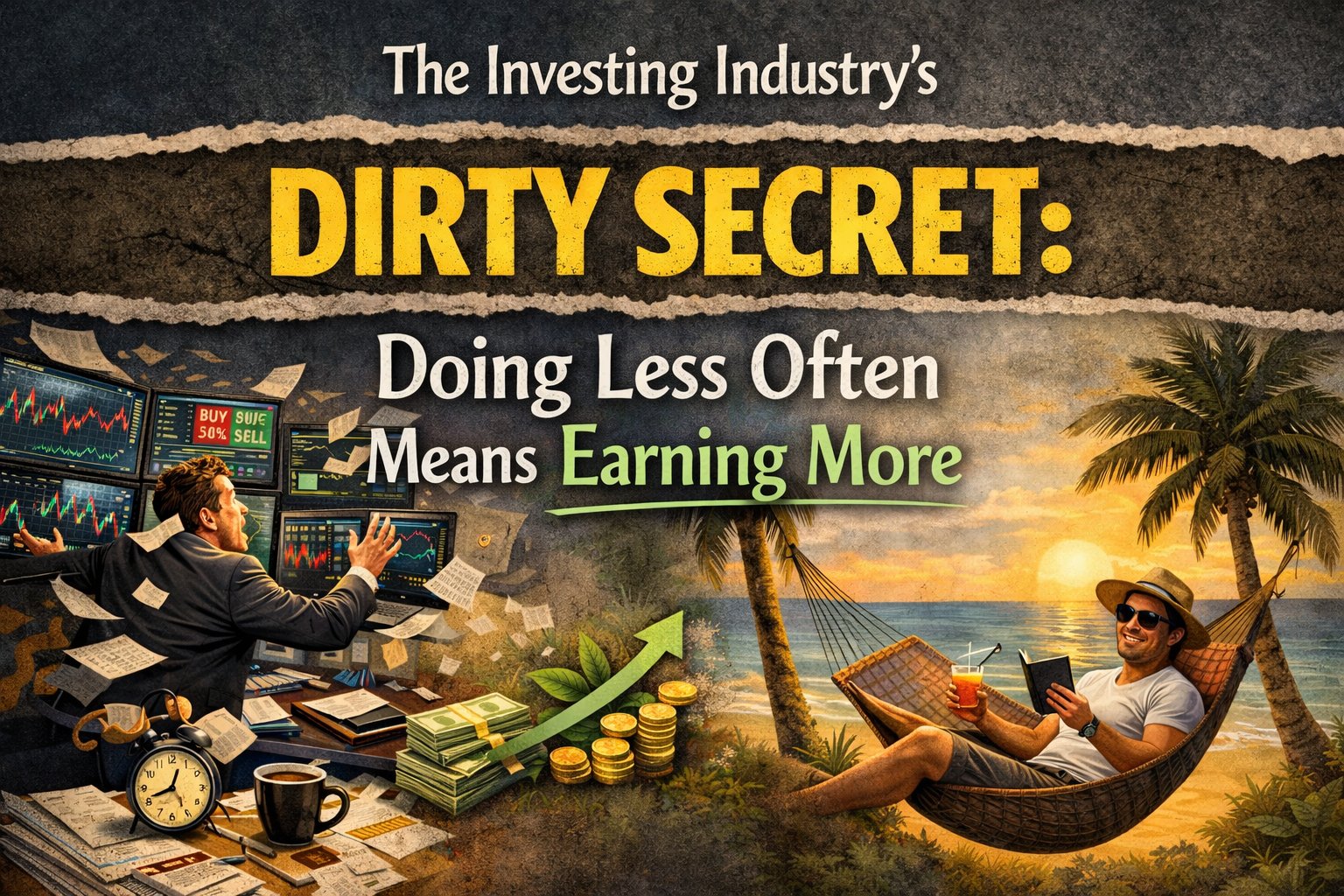
There's a quiet conspiracy in the investment world. It doesn't involve insider trading or hidden fees — though those are real problems too. It's something more insidious: the carefully cultivated belief that good investing looks like doing things.
Watch financial news for an hour. You'll see breathless analysts reacting to every tick in the market, portfolio managers talking about their latest "strategic repositioning," and a rotating cast of experts with urgent opinions about what you should be buying or selling right now. The implicit message is hard to miss: the best investors are active, decisive, and always one step ahead.
This is what psychologists and behavioural economists call the bias for action — the deeply human tendency to equate movement with progress, and stillness with failure.
Why the Industry Loves Your Impatience
Let's be direct about who benefits from your urge to act. Brokers earn commissions on trades. Fund managers justify their fees by demonstrating activity. Financial media sells advertising by keeping you glued to the screen. The entire ecosystem is built on the premise that you should be doing something with your portfolio — and doing it frequently.
This isn't a conspiracy so much as a set of misaligned incentives. The industry profits from turnover. You, the investor, generally don't.
Decades of Dalbar research consistently shows that average investors dramatically underperform the very funds they invest in — not through poor fund selection, but through poorly timed buying and selling driven by emotion.
Every trade carries costs: brokerage fees, bid-ask spreads, and tax consequences. But the subtler cost is the one that shows up in long-run return data: the gap between what the market earns and what individual investors actually take home. We buy high, gripped by optimism. We sell low, gripped by fear. Then we buy again, convinced the recovery is finally here. All this activity destroys value while generating revenue for everyone except us.
The Inactivity Premium
Here's what the noise drowns out: in investing, doing nothing is often the highest-conviction strategy available.
Much of the real money in investing has been made by people who simply sat on their hands.
— Charlie Munger
Warren Buffett — probably the most studied investor in history — has described his ideal holding period as "forever." Jack Bogle, founder of Vanguard and patron saint of the passive investing movement, spent decades making a single, unglamorous argument: don't just do something, stand there.
The mathematics are unforgiving in their simplicity. A portfolio that earns 8% annually and is never touched grows dramatically over decades. The same portfolio, churned even modestly in response to news and emotion, will lag — not because the investor made dramatically wrong calls, but because small frictions and mistimed decisions compound in the wrong direction just as surely as returns compound in the right one.
The Psychological Trap
So why is it so hard to do nothing?
Part of it is evolutionary. Human brains evolved in environments where passivity in the face of a threat was genuinely dangerous. Sitting still while a predator approached was a bad strategy. Action — any action — at least gave you a chance. We are wired to feel that inaction is negligence.
This instinct is spectacularly maladapted for financial markets. Markets generate constant noise, most of which is meaningless. A quarterly earnings miss, a central bank comment, a geopolitical headline — these events trigger the same alarm responses in our brains that genuine threats do, and they come with an interface (the trading app on your phone) that makes acting on that alarm trivially easy.
There's also the issue of regret. If we act and things go wrong, we can tell ourselves we tried. If we do nothing and things go wrong, we feel the full weight of having failed to prevent it. Psychologically, action provides cover even when it produces worse outcomes.
What Sophisticated Inactivity Actually Looks Like
None of this is an argument for complete passivity or indifference. The point is not that you should never make investment decisions — it's that those decisions should be deliberate, infrequent, and grounded in a long-term plan rather than a reaction to today's news.
The discipline involves a few concrete practices. Having a written investment policy — even a simple one — acts as a commitment device that makes reactive trading harder to justify. Automating contributions removes the temptation to time the market. Checking your portfolio less frequently is not laziness; it's a form of risk management against your own worst instincts.
Rebalancing periodically — say, once a year — is the kind of intentional, rules-based action that actually does add value. It forces you to buy what's fallen and trim what's risen, the opposite of what emotion would have you do.
The Hardest Skill in Investing
In most domains, effort and outcome are correlated. Work harder, get better results. Investing is one of the few fields where this relationship is genuinely inverted much of the time. The discipline of not reacting, of tolerating uncertainty without reaching for the trading app, is the hardest skill most investors will ever try to develop — and the one the industry has the least interest in teaching you.
The best investment action you might take today is the decision to take no action at all.
Hold your positions, trust your plan, and let compounding do the work that television says only constant vigilance can accomplish. That's not exciting. It won't make good television. But it tends to make good returns.