
Many investors have a familiar moment. A few months pass. The advisor has not called. The portfolio statement looks much like it did last quarter. And a quiet voice asks: "What am I paying for?"
That question is reasonable. Paying for advice should produce value, and you are right to ask what that value is. But the answer is not always visible in activity. In investing, the most valuable work is often the work that results in nothing dramatic happening at all. This article explains why, and gives you a practical way to tell the difference between a patient advisor and an absent one.
In This Article
01
Why We Equate Activity With Value
Human beings are built to respond to threats. When something feels uncertain, our instinct is to act: to move, to change, to take control. In many areas of life this instinct serves us well. In investing, it often works against us.
Behavioural economists call this action bias, the tendency to favour intervention even when there is no evidence that intervention will improve the outcome. Related to it is the illusion of control, the feeling that frequent decisions give us more command over results than we actually have.
Put these together and a predictable pattern emerges. We judge a professional by what we can see. A visible change feels like diligence. A visible silence feels like neglect. But what we can see is only a small part of the work, and sometimes the least important part.
Would you judge a doctor by how often they change your medicines?
If your doctor changed your prescription every month, you would worry. You would want to know why. A good doctor often says "your condition is stable, continue the same treatment, and we will check again in six months." That is not neglect. It is a sign that the treatment is working and that the doctor is not making changes for the sake of appearing busy. Investing works the same way.
02
What Happens When Nothing Seems to Happen
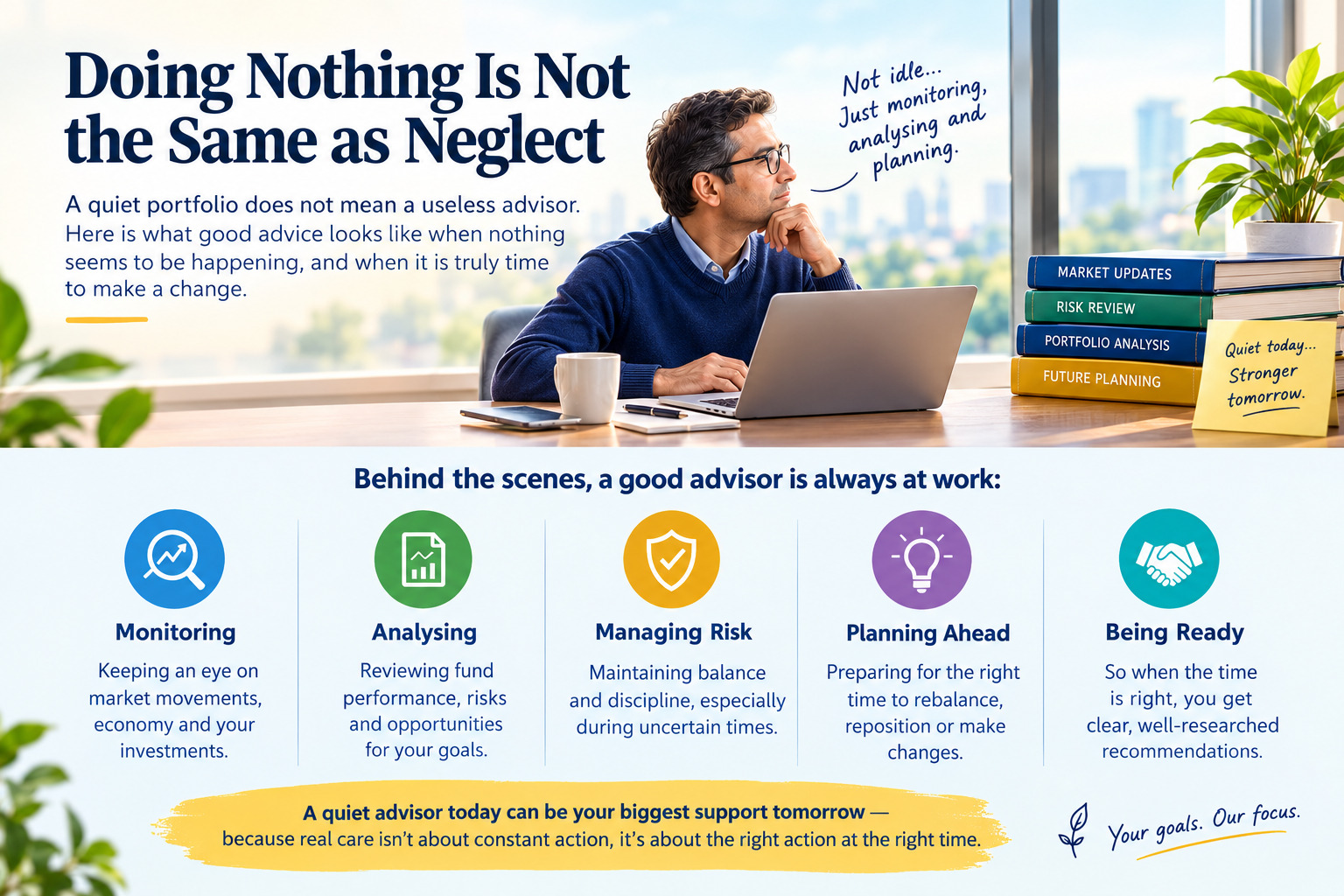
When your advisor stays quiet, a good one is rarely idle. Much of the valuable work happens in the background, and some of it is easy to miss. A competent advisor's ongoing responsibilities typically include:
- Checking that your asset allocation still matches your goals. Your mix of equity, debt, and other assets should reflect your time horizon and risk capacity, not the day's headlines.
- Reviewing whether each fund is still doing its job. This means looking at consistency of process, portfolio changes, risk characteristics, and how the fund behaves across market cycles, not just its most recent return.
- Monitoring life changes. A new job, a child's education timeline, a home purchase, or a change in health can alter what your portfolio needs to do.
- Watching for drift. Over time, strong performers grow to dominate a portfolio and weaker ones shrink. Rebalancing restores your intended risk level, but it is done when drift is meaningful, not on a schedule for its own sake.
- Keeping SIPs, goals, and nominations on track. Administrative details such as mandate renewals, KYC updates, and nominee records quietly determine whether your plan actually works when it is needed.
- Staying current on regulation and tax rules. Changes in capital gains taxation, for example, can alter the best way to withdraw or rebalance. An advisor who tracks these changes protects you from costly surprises.
Most of this work produces no dramatic event. Its success is measured by what did not happen: no panic selling during a correction, no chasing last year's top performer, no unnecessary switching that triggers taxes and exit loads, and no drift that quietly pushed your risk far above what you can tolerate.
In other words, the value of a good advisor often shows up as the absence of mistakes. That is harder to notice, but it is no less real.
The Value That Never Shows Up on a Statement
Beyond the routine monitoring, there is a category of value that most investors never see on any report. It is the value of behavioural coaching: helping you hold your course when your own instincts pull you in the wrong direction.
Consider the investor who, during a sharp market fall, wants to sell everything. Or the one who, after a strong rally, wants to pour in a large lump sum at the top. In both moments, the financial plan has not changed. Only the emotion has. A good advisor's job in those moments is to slow the decision down, revisit the goal, and ask whether the situation has truly changed or only the mood has.
A good advisor is often most valuable on the days when they say, "Let's not do anything."
This is sometimes described as an advisor's "behavioural alpha": the improvement in client outcomes that comes from avoiding costly emotional decisions. The exact size of that benefit varies widely and depends on the investor, but the principle is widely accepted. The biggest threat to most long-term portfolios is not a bad fund. It is an investor who sells at the wrong time.
There is also a quieter kind of value: clarity. A written plan that connects your savings to specific goals, such as a child's education, retirement income, or a house, gives every investment a purpose. When markets swing, you are not asking "What should I do?" You are asking "Is my plan still on track?" That single shift can prevent years of costly reactions.
04
The Real Cost of Unnecessary Action
Frequent portfolio changes are not free. They carry costs that are easy to overlook because they arrive quietly, one transaction at a time.
The table below shows the main types of cost that frequent switching can create.
| Source of cost | How it appears | Why it matters |
|---|---|---|
| Taxes | Short-term capital gains on equity funds | Gains realised early are taxed at higher rates than long-term gains |
| Exit loads | Charges on redemption before a stated period | Early exits reduce the amount you actually keep |
| Timing errors | Re-entering after markets have already recovered | Missing a few strong days can meaningfully lower long-run returns |
| Behavioural errors | Buying after rallies, selling after falls | Emotion-driven decisions tend to lock in losses and chase performance |
| Lost compounding | Money leaving the market and not returning | Compounding depends on time invested, not just the amount invested |
The uncomfortable truth is that an investor who checks their portfolio every week often ends up with a worse result than one who reviews it once a year. The difference is rarely the funds they chose. It is what they did in response to short-term noise.
Why does a plant grow faster when you stop digging it up?
Every time you dig up a seedling to check its roots, you slow its growth. The plant does not need your constant inspection. It needs water, sunlight, and time. Your portfolio works the same way. Regular checking is healthy. Constant uprooting is not.
05
Patience Versus Neglect: How to Tell the Difference
This is the heart of the matter. A quiet advisor can be either patient or absent. Both look similar from the outside for a few months. The difference becomes clear when you look at what is happening beneath the surface.
| A patient, engaged advisor | An absent or neglectful advisor |
|---|---|
| Has a written plan tied to your specific goals | Cannot clearly explain what your portfolio is for |
| Explains why each holding exists and what would make them change it | Holdings were chosen once and never revisited |
| Reaches out proactively when your life or the rules change | Contacts you only when they want to sell something |
| Reviews progress at a sensible, agreed frequency | Reviews are either absent or irregular without explanation |
| Says "no change needed" when that is the honest answer | Makes frequent switches that generate commissions but little benefit |
| Responds promptly when you have a question | Is hard to reach when you actually need help |
The key insight is this: a patient advisor is not defined by silence. They are defined by purpose, clarity, and responsiveness. If you can see the plan, understand the reasons behind your holdings, and reach your advisor when you need to, then a quiet period is usually a sign of stability.
06
When It Is Genuinely Time to Change Advisors
None of this means every advisor deserves loyalty regardless of performance. Patience is a virtue, but so is accountability. There are real warning signs that justify a change, and they have little to do with how often your advisor calls.
Signs That Warrant a Serious Review
- Your advisor recommends frequent switches between products without a clear, documented reason.
- You cannot get a straight answer about the costs, commissions, or risks of what you own.
- Recommendations seem driven by product targets rather than your goals and risk profile.
- Your questions go unanswered for long periods, especially during market stress or life events.
- You do not have a written plan, and no one has ever discussed what success looks like for you.
- Your advisor discourages you from asking questions or dismisses your concerns.
- Your life circumstances have changed significantly, and your plan has not changed with them.
If several of these apply, a conversation is overdue. If none of them apply and the main complaint is simply that the advisor has not been in touch, the more likely problem is a difference in expectations rather than a lack of competence. That difference is worth addressing directly.
07
Questions Worth Asking Your Advisor
Rather than measuring your advisor by how often they call, consider asking the questions below. A good advisor will welcome them, because informed clients make better long-term partners.
- What is my financial plan, and which of my goals does each investment serve?
- How often will we review the plan, and what would trigger an earlier review?
- What would have to change in my life or in the market for you to recommend a different allocation?
- What are the total costs of my portfolio, including expense ratios, exit loads, and taxes?
- How did my portfolio behave during the last sharp market fall, and what did we do about it?
- What should I do, and what should I deliberately avoid doing, in the next market downturn?
- How can I reach you when I have a concern, and how quickly can I expect a response?
The Short Version
A quiet advisor is not automatically a poor one. A good advisor is measured by clarity of plan, discipline in process, honesty about costs and risks, and availability when it matters. A portfolio that is not being constantly changed is often a portfolio that is being carefully managed. The real question is not "Did my advisor do something this quarter?" but "Is my plan still doing what it was built to do?"
A Gentle Reminder Before You Act
The next time you feel the urge to change your portfolio because of a headline, a friend's tip, or a few disappointing months, pause and ask: Has my goal changed, or has only my mood changed? If the goal has not changed, the plan probably has not either.
Good investing is often boring. That is not a flaw in the process. It is the process working as intended.
Not sure whether your current plan still fits your goals? Let's review it together.
Book a Portfolio Review Chat on WhatsApp